

From viral social media challenges, addictive algorithms, and sycophantic chatbots to the pitfalls of AI tools on children’s brains, the dangers of tech for kids have been making headlines again lately. In a recent preprint, researchers found that college students who relied on ChatGPT to write essays could not quote from their “own” work, and their brains showed less brain activity compared with those who relied on internet research or who used no outside research at all.
Aside from misuse of AI, screen time plays a major role in affecting children’s brain development and regulation of the neurotransmitter dopamine, one of the brain’s “feel-good” hormones, but the issue predates the rise of handheld devices and social media. Before tablets, there was old-fashioned CRT TV, chock-full of Saturday-morning cartoons—and commercials aimed at kids—cast as the villain, until parents forced changes to programming with the Children’s Television Act of 1990.
The Dopamine Drive
Dopamine, essential for our bodies’ movement and memory functions, has long been known as the neurological culprit responsible for junk food cravings and obsessive video game playing, among other addictive behaviors. But today, it’s easier to distinguish between, say, cupcakes and carrots than versus educational materials that truly help kids learn and relatively benign content that triggers a dopamine rush in kids. While there are well-documented risks of unrestricted screen time—at any age—digital literacy is an essential skill, and instilling it earlier can help kids detect the difference between dopamine-hitting content bursts and more sustained activities that can help them learn and grow. Engaging in active, goal-oriented screen-based tasks that require focus can benefit kids, teaching them to use technology as a tool rather than a crutch. If battles over screens cause headaches in your home, read on for four top tips you can use to help kids leverage those devices to learn new skills and develop patience and perseverance.

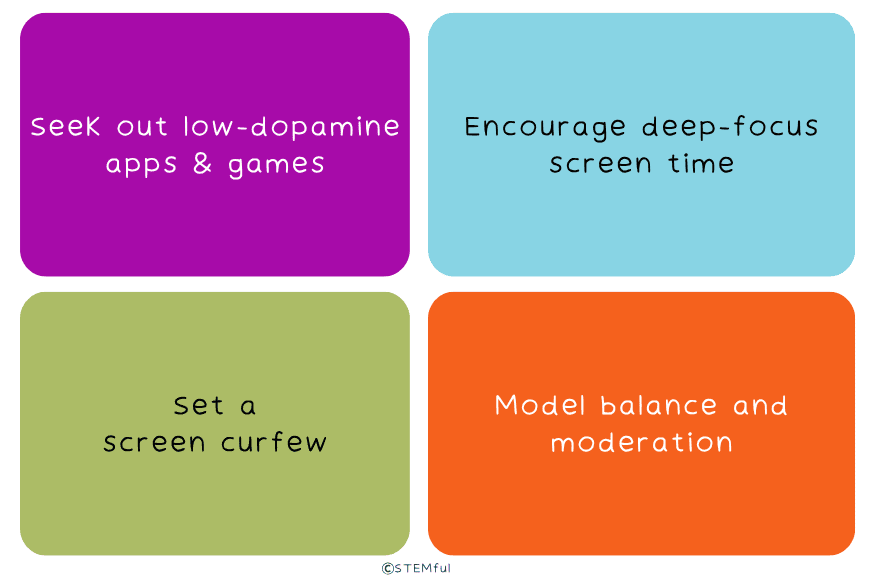
1. Seek Out Low-Dopamine Apps and Games
Educational apps and games can be great activities for kids and are lifesavers for parents and caregivers on long road trips or flights when tried-and-true travel classics like I spy and license plate bingo have run their course. But not all screen-based activities are created equal. The rise of so-called low-dopamine parenting has helped guide parents’ choices for apps that can assist with language and problem-solving skills. Avoiding overstimulating rewards-based apps, such as those with quick bursts of sound and fast-paced animation, can help reduce kids’ gravitation toward screen time as a distraction rather than a learning tool.
2. Encourage Deep-Focus Screen Time
While short bursts of educational apps are fine in moderation, it may seem counterintuitive to suggest that children spend more time in front of a screen. But STEM-based activities that focus kids’ attention on solving a challenging problem and reaching a goal and that engage them in deeper learning have many benefits. Coding and robotics platforms like Tinkercad, Makey Makey, and Scratch require screens to function but help kids learn new skills that encourage creative thinking and problem solving and, in a group environment, foster collaboration and socialization.
3. Set a Screen Curfew
Most parents who put kids on a strict screen time diet have discovered that reducing exposure to screens doesn’t always reduce children’s pleas for more screen time. That’s dopamine at work! But even if you’ve established time limits and allow only low-dopamine apps, even beneficial, educationally focused screen-based activities can affect sleep. While research on blue light before bed is mixed, newer studies suggest that the most dopamine-triggering behaviors, like playing video games or watching fast-paced videos, can impair sleep. And studies in children show that overstimulation before turning in can disrupt circadian rhythms and hinder deep sleep, leading to sluggishness (and the occasional tantrum) during the day.
While many devices now have modes that reduce their displays’ blue light at night, kids’ usually earlier bedtimes may not trigger those devices to lower the brightness and shift colors to promote restful sleep to benefit younger users. Ensure screen-free before bed, and establish a clear shutoff time for little ones. Keeping screens out of the bedroom—or at least outside of beds—altogether can also promote good sleep hygiene, as kids will associate bedtime and naptime with sleep rather than screens. Instead, swap tablets and other devices for a calming activity like reading a book or telling a relaxing bedtime story, cuing kids’ brains to rest.
4. Model Balance and Moderation
When we adults are engrossed in our devices for work or just a quick distraction, kids pick up on the behavior and are naturally inclined to model it. But in today’s demanding, fast-paced world, with so many of our lives digitally enmeshed, it’s tough to practice what we preach and step away from screens. While it’s nearly impossible for most of us to fully disconnect, we can balance our screen time and encourage kids—and ourselves—to go outside, interact with (human) friends, and read books that enrich our lives, help us to sleep better, and stay connected with things that matter.
For more goal-oriented, interactive STEM-based activities that use beneficial screen time to promote problem-solving and creative-thinking skills, sign your kids up for STEMful’s after-school Curiosity Creators program, designed for ages 7 to 10, and help sprout their curiosity now and in the future!
Looking to keep kiddos off their devices and emerged in a world of STEAM on no-school days? STEMful offers School Break Camps, as well as Summer Camps, for children ages 3.5 to 10.
- Sarah Schwartz, “Brain Activity Is Lower for Writers Who Use AI. What That Means for Students,” Education Week, June 26, 2025, https://www.edweek.org/technology/brain-activity-is-lower-for-writers-who-use-ai-what-that-means-for-students/2025/06.
- Charles Moss, “The Rise and Fall of Saturday Morning Cartoons,” Saturday Evening Post, May 20, 2021, https://www.saturdayeveningpost.com/2021/05/the-rise-and-fall-of-saturday-morning-cartoons/.
- Michaeleen Doucleff, “‘Anti-Dopamine Parenting’ Can Curb a Kid’s Craving for Screens or Sweets,” NPR, June 12, 2023, https://www.npr.org/sections/health-shots/2023/06/12/1180867083/tips-to-outsmart-dopamine-unhook-kids-from-screens-sweets.
- Caroline Hopkins Legaspi, “Why Do Screens Keep You Up at Night? It May Not Be the Blue Light,” New York Times, August 17, 2025, https://www.nytimes.com/2025/08/17/well/health-effects-blue-light-screen-use.html.